How to get someone banned on Instagram: violation, evidence, and the right route
To get someone banned on Instagram, report the actual rule their account breaks through Instagram's own reporting forms, with clear dated evidence attached. There is no instant-ban button. What decides the outcome is whether a real violation happened — and how fast it gets seen — not how many people hit report.
What does "getting someone banned" on Instagram actually involve?
It involves one thing you control and one you don't. You control the report: you point Instagram at a profile, post, Story, or DM and name the rule it breaks. You do not control the verdict, because a moderator or an automated check then decides whether the account really crossed a line in the Community Guidelines. That single judgement settles the case. So the honest framing of how to get someone banned on Instagram is narrow: build a report a reviewer can act on in one pass. Everything that fails — buying a panel, rounding up friends, hammering the report button — fails because it tries to win the verdict by force instead of by proof. The rest of this page works through the four things that genuinely shift that verdict: the violation, the evidence, the route, and the timing.
Is getting someone banned the same as blocking or restricting them?
No — these are five different things, and searchers conflate them. A ban (Instagram calls it disabling the account) is platform-level: Meta removes the whole account so no one can see it. Blocking is personal and does nothing to the other account — it only hides you and them from each other, and you can do it from your own settings in seconds. Restricting is a quieter personal tool that limits someone's comments and messages to you without telling them. An action block is a temporary, account-level limit Instagram applies for spammy behaviour (too many follows or comments too fast), lifting on its own after hours or days. A shadowban isn't an official term at all — it describes reduced reach when content brushes the rules, not a removal. Only a disable actually takes an account off Instagram. Getting "someone banned" means triggering that platform-level disable through a real violation report; blocking and restricting are things you control yourself and never affect their account's standing.
Which Instagram violations actually get an account banned?
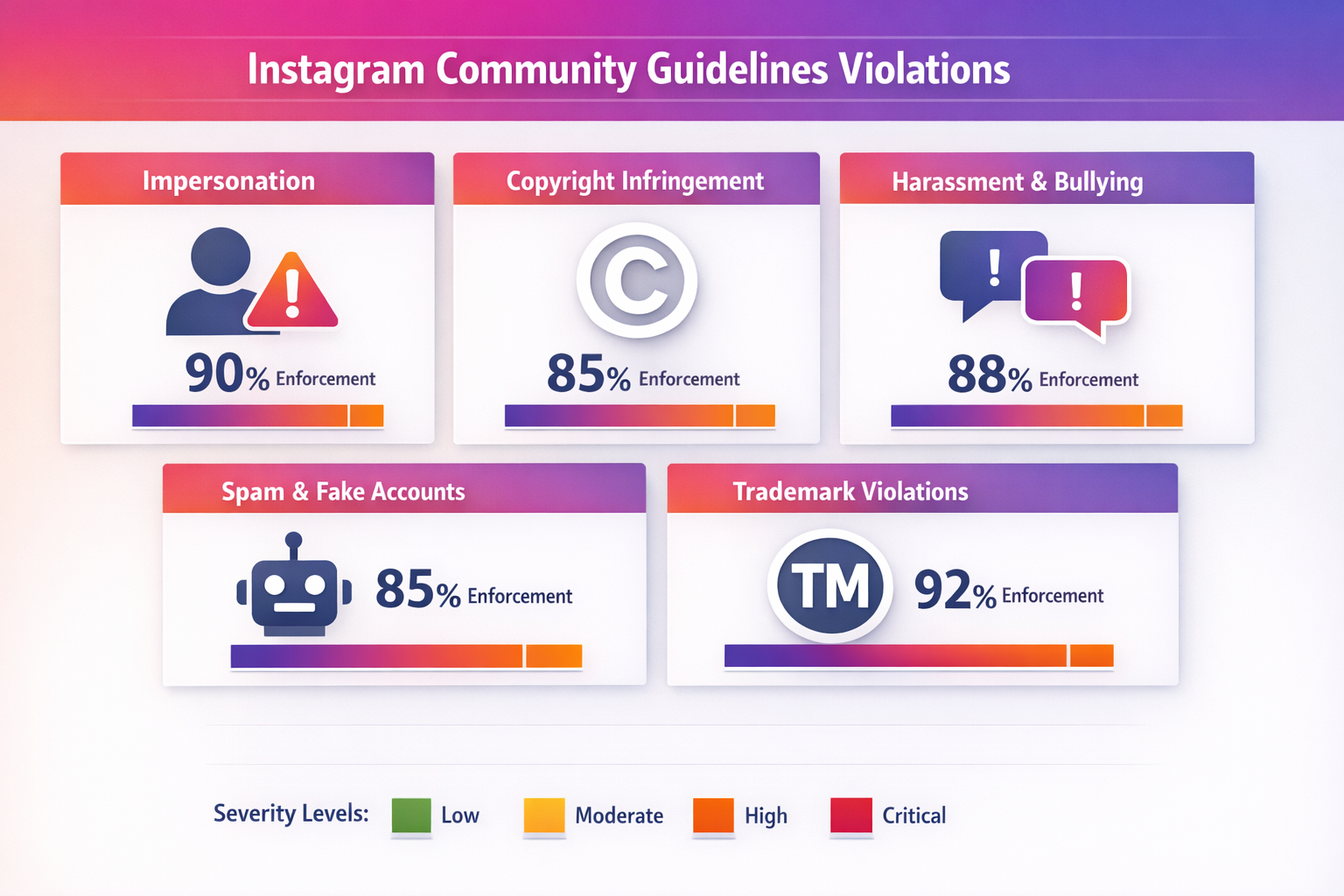
Only behaviour Instagram already prohibits will get an account removed, so the first job is matching what you've seen to a real rule. Scams and phishing, selling counterfeit goods, impersonating a person or brand, targeted harassment and bullying, sexual exploitation, and credible threats are all bannable. A profile you find annoying, a heated argument, or an opinion you disagree with is not. This is the trap behind most failed attempts: people want a rival, an ex, or a critic gone and assume enough complaints will do it, when the account breaks no guideline at all. Pick the category that genuinely fits — a fake shop is "scam or fraud," a clone of your account is "impersonation," a counterfeit reseller is "selling illegal or regulated goods." Filing under the wrong reason is the most common way a valid report stalls or gets dismissed before anyone weighs the proof.
How many reports does it take to get someone banned on Instagram?
None of the numbers people trade online are real, because report count is not the trigger. Instagram is direct about it: its Help Center states the number of times something is reported does not determine whether it is removed — what matters is whether a Community Guidelines violation actually occurred. So "how many reports to get someone banned on Instagram" has a flat answer: zero is enough if there's no violation, and one is enough if there is. Lining up twenty friends or paying a service to fire five hundred complaints adds no weight; Instagram's spam systems treat coordinated bursts as inauthentic and discount them. That mechanic is also why mass reporting an account on its own rarely lands a ban. The honest play is one accurate report with evidence, not a pile of empty ones. The scale of Meta's own detection makes the point: it removed roughly 10.9 million scam-related accounts and actioned about 159 million scam ads across its platforms in 2025, per Social Media Today — removals driven by automated enforcement at scale, not by how many users hit report.
Why can one report ban a new account but a thousand bounce off an established one?
Because Instagram weighs the account being reported, not just the report. Reviewers and automated systems read a credibility signal often called a trust score: account age, posting history, engagement quality, verification, and any prior strikes. A brand-new throwaway with one clear scam post and a single accurate report has nothing to lean on, so it can be disabled quickly. An established account with years of history, a clean record, and real engagement is treated as higher-trust, so even a flood of complaints is examined harder and discounted as inauthentic if no genuine violation is found. This is the real mechanism behind our "count doesn't matter" thesis: a thousand reports against a high-trust account that broke no rule change nothing, while one well-evidenced report against a low-trust account that clearly did can land. The variable is credibility plus a real breach — never volume alone. Less than 1% of content on Facebook and Instagram is removed for policy violations, with under 0.1% removed in error, per the Meta Integrity Reports (Q3 2025) — proof that removal hinges on a genuine breach, not report count.
What evidence makes an Instagram report stick?
Proof is what lets a reviewer decide in a single pass instead of bouncing your report back, so capture it before anything else. Screenshot the offending posts, Stories, comments, and DMs while they're still live, since violating accounts delete fast the moment they sense trouble. Keep the timestamps visible and note the exact @username and post URLs. For a scam, save the payment request, the fake giveaway, or the phishing link; for impersonation, have a photo of your own profile and your ID ready; for counterfeit, keep proof you own the brand. Strong evidence does more than support a ban — it speeds it up, because a clear case skips the back-and-forth that drags weak reports out for weeks. If you'd rather not assemble the pack yourself, this is exactly the documentation work a legitimate Instagram ban service handles before filing.
Which official route should you use, and can you get someone banned on Instagram immediately?
Use the channel built for the specific violation, and set the expectation honestly: you can't get someone banned on Instagram immediately on demand. Most cases go through the in-app flow — open the profile or post, tap the ••• menu, choose Report, and pick the true reason. Some violations have faster, dedicated routes. The table below maps the common ones; "immediately" only really happens for the severe, auto-detected categories that Instagram's systems action before a human even reads your report.
| Violation | Official route | What to attach |
|---|---|---|
| Scam, phishing, fake shop | In-app report → "Scam or fraud" | Screenshots of the offer, link or payment request |
| Impersonation of you or your brand | Dedicated impersonation form | Photo ID; the real and fake @usernames |
| Counterfeit, trademark, copyright | Instagram's intellectual-property forms | Proof of brand or content ownership |
| Harassment, bullying, hate | In-app report → matching reason | Dated screenshots of the targeting |
| Threats, child safety, terrorism | In-app report; contact authorities too | Anything you can safely preserve |
How do you report an Instagram account, step by step?
The in-app report flow is the same idea on both mobile and desktop: open the offending profile or post, find the overflow menu, choose Report, then pick the true reason. Here is the click-by-click path.
On mobile (iOS / Android):
- Open the violating profile, post, Story, or Reel.
- Tap the ••• menu in the top-right corner.
- Tap Report, then Report account (or Report post).
- Choose the reason that genuinely fits — "Scam or fraud," "Pretending to be someone," "Bullying or harassment," and so on.
- Follow the prompts and submit; you'll get a confirmation in your support inbox.
On desktop (browser):
- Open the account or post at instagram.com.
- Click the ••• (or ⋮) menu beside the username or above the post.
- Click Report and confirm whether you're reporting the account or a single post.
- Select the matching violation reason and submit.
Pick the reason that matches the real rule — a wrong category is the most common way a valid report stalls. For impersonation, copyright or trademark, skip the in-app flow and use the dedicated forms in the table above instead.
How do you file a DMCA or IP takedown for stolen content?
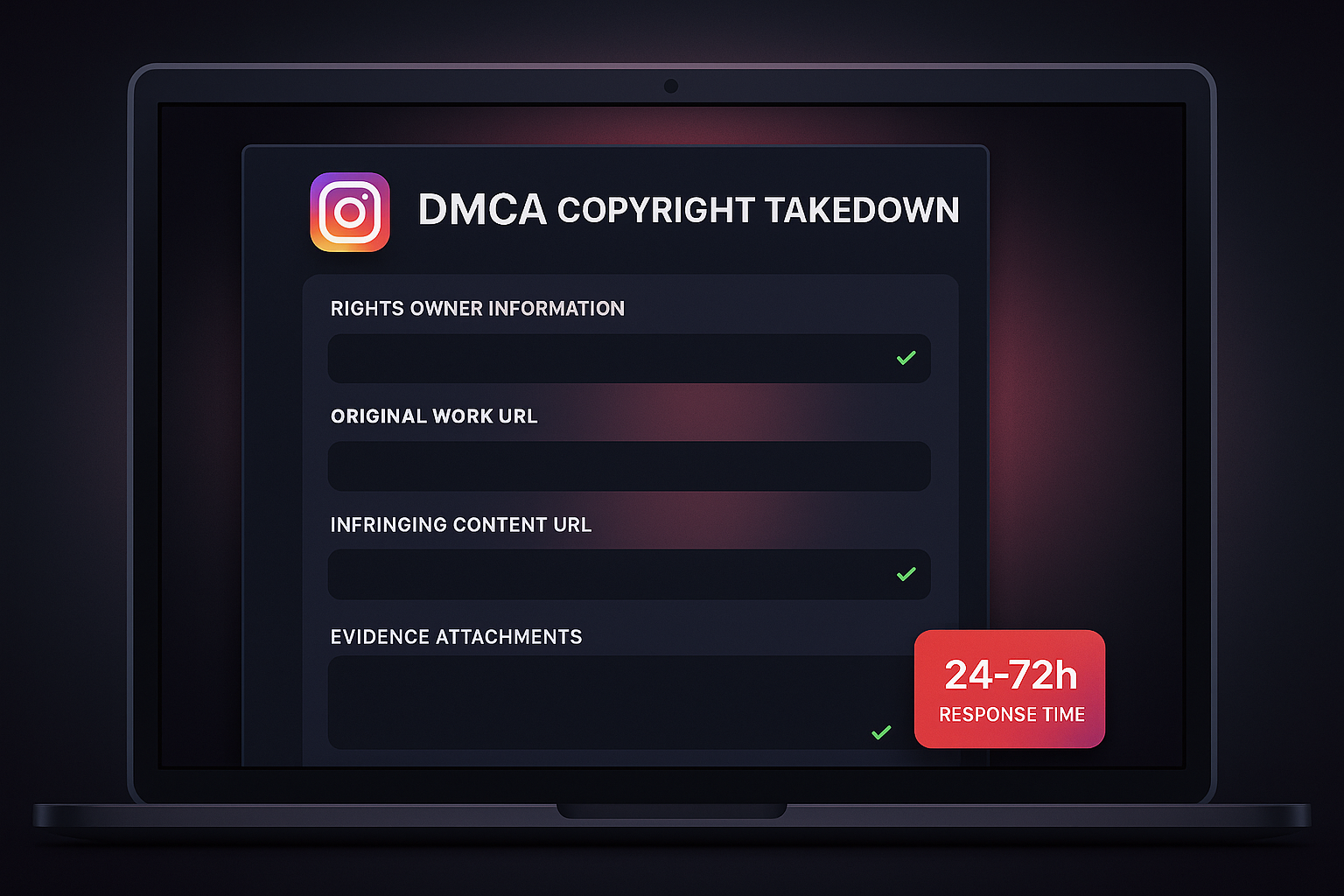
When the violation is your copyrighted photos, video, or brand being used without permission, the in-app report isn't the strongest route — Instagram's intellectual-property forms are, and a copyright claim runs as a formal DMCA takedown notice. To be valid, that notice has to contain a few specific things: proof you own the work (or authority to act for the owner), the exact infringing post URLs, identification of your original work, your contact details, a good-faith statement that the use isn't authorised, and a statement under penalty of perjury that your claim is accurate — signed with your name. Trademark claims go through Instagram's separate trademark form with proof of the registered mark. Two cautions: copyright and trademark claims are not anonymous, so the account may learn who filed; and filing a false IP claim has real legal exposure. Done properly, an IP takedown is one of the faster, more reliable routes because ownership is provable rather than a matter of judgement.
How long does Instagram take to ban an account?
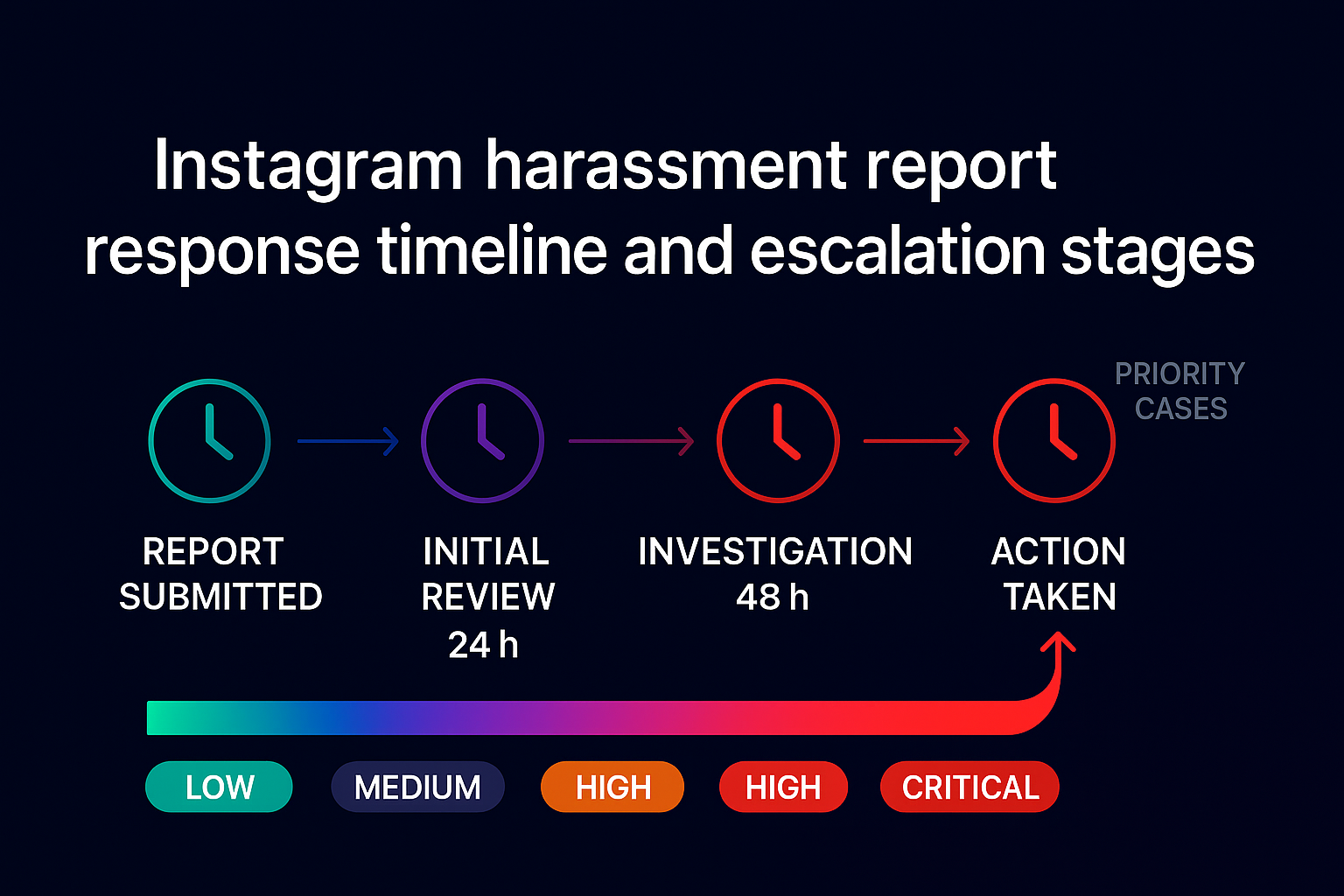
There's no published deadline, and honest help won't pretend otherwise. In practice the wait stretches from a few hours to roughly two weeks, set by how severe and how obvious the breach is rather than by anything you can pay for. A blatant phishing scam or a credible threat can come down fast; a tangled harassment dispute sits longer while a reviewer reads context. Instagram triages by seriousness, not by queue position, so a fresh report on something dangerous can overtake an older, milder one. Meta runs a strike model underneath all this: a first strike is a warning, two to six strikes bring feature restrictions, the seventh adds a one-day block, and ten or more triggers a 30-day restriction, per the Meta Transparency Center. Read those thresholds carefully: they are escalating account-level restrictions, not a counter that flips to a permanent ban once you hit a number. A full, permanent disable still depends on the severity of the breach, not on reaching ten strikes — repeated violations build pressure, but they don't guarantee the account is removed. You may also have seen a confident "24–48 hour review" figure repeated across other guides; treat it as folklore, not policy. Instagram publishes no fixed turnaround, and real reviews run from a few hours to about two weeks depending on severity and evidence.
When does Instagram disable an account on the first strike?
Only the gravest categories skip the strike ladder entirely. Meta states that "a violation may be severe enough that we'll disable your account after one occurrence, as in the case of posting child sexual exploitation content," per the Meta Transparency Center, and it handles credible threats of violence and terrorism with the same urgency. These breaches are largely caught by automated detection, which is why action on them can feel near-instant and rarely depends on your report at all. Everything milder — spam, a rude comment, a borderline post — runs through warnings and limits first and climbs slowly. The practical lesson is plain: the accounts that fall fastest are the ones doing serious, clearly illegal harm, and if what you're reporting is genuinely that severe, route it to the right authority or hotline as well, not Instagram alone.
Why do "instant ban" tools and report-bots never work?
Because the only product an "instant ban anyone" seller can ship is a wasted fee or a crime. The harmless version burns your money: automated report bots and paid panels spray complaints from throwaway accounts that Instagram's spam filters bin before any reviewer sees them, and the so-called spam-report bots fare no better. The dangerous version is real and documented — ProPublica reported in 2023 on an operator known as OBN who triggered genuine bans with fabricated impersonation and self-harm reports, then charged victims $3,500 to $5,000 each to get their accounts back — the racket usually marketed as "ban-as-a-service." Filing knowingly false reports also breaks Meta's rules against misusing reporting tools, so the system can action you instead. Scammers prey on this urgency: the FTC reported people lost $2.1 billion to fraud that started on social media in 2025, with Instagram the third-costliest platform behind Facebook and WhatsApp, per the FTC.
What if your own account is wrongly banned by a false report?
If a ban-as-a-service operator or a vengeful rival gets your legitimate account disabled, you have a defined appeal path — don't pay anyone a "restore" fee. Open Instagram and look for Account Status (Settings → Account → Account Status, or the prompt shown when you try to log in); it lists what Meta thinks you violated and offers a Request review button. Submit that review, and if the system asks, verify your identity with a photo of your ID or a video selfie — this is exactly the proof a false impersonation report can't survive. Keep your explanation short and factual. To harden yourself against retaliation before it happens: get verified if you can, keep your contact email and phone current so recovery options work, save dated evidence of your real ownership and posting history, and switch on two-factor authentication so an attacker can't hijack the account outright. A well-documented, verified account is far harder to take down with a fabricated claim, and far quicker to restore if someone tries.
What should you do after you've filed the report?
Wait, watch, and resist the urge to refile in bulk — re-sending the same complaint is the one move that genuinely backfires. Check your support inbox and account-status notifications for the decision; Instagram confirms reports and tells you when it finds a violation. If a real breach was clearly missed, refile once with sharper, dated evidence under the correct category, and for copyright or trademark claims a polite follow-up after about 48 hours of silence is reasonable. Keep an eye out for the account resurfacing under a tweaked handle, since banned offenders rebuild; a fresh report on the new profile keeps the case alive. If the account is impersonating you or squatting on your name, that may be a stronger, separate claim — the path we cover under claiming an Instagram handle. For tangled cases, or a report that's already been ignored, tell us about the profile and we'll map the official route with you, the same standard across every takedown we handle.
Sources
- Instagram Help Center — Abuse & Spam (report count does not determine removal)
- Instagram — Report an impersonation account (dedicated form)
- Meta Transparency Center — Restricting accounts (the strike system)
- Meta Integrity Reports, Q3 2025 — content removed for policy violations vs in error
- Social Media Today — Meta scam-account and scam-ad enforcement data, 2025
- Meta Transparency Center — Disabling accounts (first-occurrence for severe violations)
- Meta — Inauthentic Behavior policy (misusing reporting tools)
- ProPublica (2023) — the Instagram ban-and-restore fraud
- FTC (April 2026) — reported losses to social-media scams
FAQ
What gets someone banned on Instagram fastest?
The most serious, clearly illegal breaches move fastest: child-safety material, credible threats of violence, and terrorism can disable an account on a single confirmed strike. Scams and phishing follow once proof is attached. A profile you simply dislike trips none of this and stays up.
Can you get someone banned on Instagram immediately?
Not on demand. There is no instant-ban switch a report flips. Only the gravest auto-detected violations are actioned within hours, and Instagram's own systems do that, not your report. An ordinary report enters a review queue, so any tool promising an immediate ban is selling fiction.
How many reports does it take to get someone banned on Instagram?
No fixed number. Instagram states the count of reports does not decide removal, so one well-evidenced report of a real violation outweighs hundreds of empty ones. Coordinated mass reports are filtered as inauthentic and can rebound on the senders.
How long does Instagram take to ban an account after a report?
There is no guaranteed turnaround. Reviews run from a few hours for blatant, severe breaches to a couple of weeks for context-heavy cases like harassment. Severity and evidence quality set the pace, not volume. Reports are triaged by seriousness, not in the order they arrive.
Will the person know I reported their Instagram account?
No. In-app reporting is anonymous and the account is never told who flagged it. The exception is formal intellectual-property claims such as copyright or trademark, where your name may be passed on as part of the legal process behind the takedown.
What happens if I report an account that broke no rule?
Nothing happens to that account, and repeating the report will not change the outcome. Knowingly filing false reports to get a clean account banned breaks Meta's rules on misusing reporting tools, and the system can action the reporter instead of the target.
What happens to the posts, handle and followers when an account is banned?
When an account is disabled, its posts, Stories, Reels and follower connections go offline with it and stop being publicly viewable. The owner loses access to the content and following. After a permanent disable the handle can eventually free up for someone else, though Instagram does not guarantee when.
Is the "24 to 48 hour" Instagram ban time people quote accurate?
No. Instagram publishes no fixed review window, so the widely repeated 24–48 hour figure is folklore, not policy. In reality reviews run from a few hours for blatant severe breaches to about two weeks for context-heavy cases, set by severity and evidence quality rather than a timer.