Instagram ban as a service: what you are really buying, the cost, and the cons
Instagram ban as a service means paying a third party to get an account removed. The honest version documents a real rule violation and files it through Instagram's official channels for a per-case fee. The dishonest version sells fake reports against anyone for a flat price, and it is both illegal and usually a scam.
Type "instagram ban as a service" into a search bar and you land on two completely different products wearing the same name. One is a quiet corner of online-safety work: someone gathers proof that a profile breaks the rules and reports it properly. The other is a fraud market that has been written up by security journalists for years. This page separates them, walks through what a real service charges, and answers the three questions buyers actually ask before they pay.
What are you actually paying for with an Instagram ban service?
You are paying for a documented case and the judgement to file it correctly, not for a delete button. An honest Instagram ban as a service treats every request as a miniature investigation: it confirms the profile breaks a real rule, captures dated evidence, picks the exact Community Guideline and reporting form, submits through Instagram's own channels, then chases the result. The criminal version skips all of that and simply fires fake complaints at whatever target you name. That gap in method is the whole story. It decides whether the work is lawful, whether it stands any chance of sticking, and whether Instagram treats your case as a legitimate report or flags you as the one abusing the system. Anyone selling the second thing is selling a crime with a customer-service veneer.
Is it legal to get someone banned on Instagram?
It is legal when the report is honest, and only then. Anyone is entitled to flag a profile that breaks the Community Guidelines or the law, and delegating that to a paid agent is no different in principle from hiring any other representative. The hinge is truth. File a knowingly false complaint, such as a fake impersonation claim against a person who is obviously themselves, and you slide toward defamation or tortious interference, while plainly breaching Meta's rules against misusing the reporting tools (Meta Inauthentic Behavior policy). Instagram is also built to catch this. It states that the number of reports does not determine an outcome and that it discounts coordinated flagging (Instagram Help Center). And it acts on genuine abuse at scale: in the first half of 2025 Meta removed roughly 10 million Instagram and Facebook accounts impersonating large creators and took action on about 500,000 accounts pushing fake engagement (CNBC, 2025). So the fraud route loses twice: it usually fails, and it brands you the abuser.
How do scammers actually ban an Instagram account?
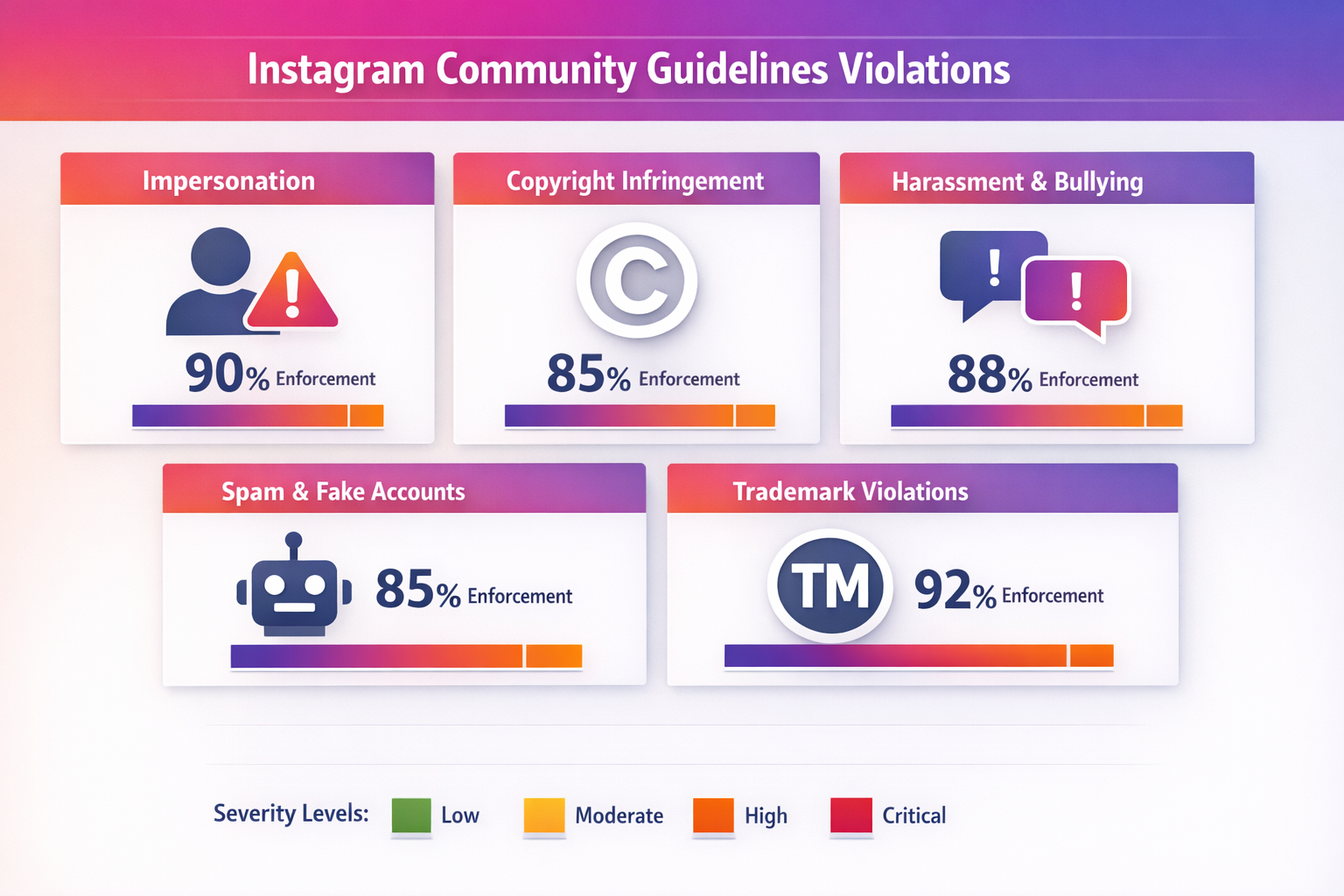
The fraud trade leans on two attack vectors, and almost every documented case is one or the other. The first is the impersonation clone: the scammer copies a target's name, photo and bio onto a fresh or stolen verified account, then reports the real person for "pretending to be" the clone. The second is the coordinated false self-harm or suicide report. Security researchers at Kaspersky describe why it works so well — Instagram "takes the easier path" and restricts an account on a self-harm flag without reviewing the content, because the cost of leaving a genuine crisis unaddressed is too high (Kaspersky). That is the real-world exception to "reports don't decide outcomes": false impersonation and self-harm claims frequently trigger automated action before a human checks anything. Neither method requires your password, which is exactly why a hardened, verified account is the best defence — and why the wreckage is reversible on appeal.
How much does an Instagram ban service cost?
A trustworthy provider quotes per case, because the cost reflects labour and complexity, not a fixed "ban" price. A single, clearly documented violation is cheap to handle; a contested claim, a serial offender, or a cluster of linked accounts takes more work and costs more. The scam market runs on the opposite logic: investigators tracking these sellers report ban prices as low as $5 to $60, sometimes scaled by the target's follower count, paired with $3,500 to $4,000 to "restore" the same account afterwards — and some operators demand a roughly $1,500 refundable deposit just to start. At the criminal end, the model ProPublica investigated in 2023 had an operator known as OBN charging up to $5,000 a service, posing as a Meta staffer, then billing the banned victims again to undo the damage; influencer Danii Banks said the bans cost her around $300,000 in lost income and Kay Jenkins paid OBN more than $10,000, while the operator boasted "I made about $300k just off banning and unbanning pages." Investigators later linked the operation to a suspect, Edwin Reyes-Martinez (ProPublica, 2023). The pattern to recognise: a cheap flat fee with a guaranteed ban attached is the opening move, and the four-figure "restore" bill is the same crew finishing the job.
Where the money actually goes
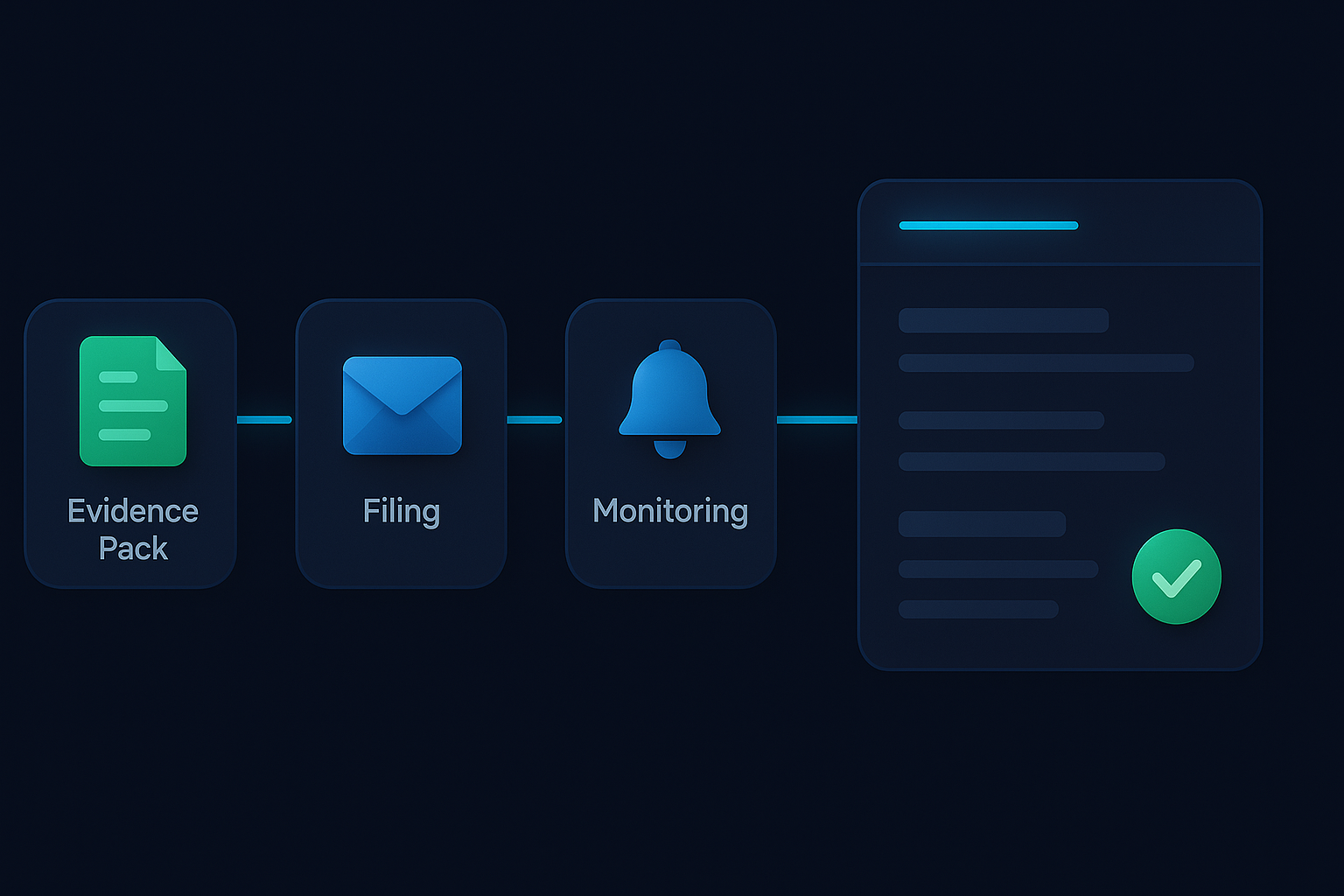
The fee on an honest case covers four pieces of real work, and none of them is a bribe or a bot.
- Triage. Reviewing the profile and confirming it genuinely breaks a rule before any report is filed.
- Evidence pack. Capturing dated screenshots of the scam, clone, counterfeit listing, or abuse before the offender deletes them.
- Correct filing. Matching the behaviour to the right guideline and the right form, including the impersonation form only the affected person or their representative can submit (Instagram impersonation form).
- Follow-up. Tracking the decision, refiling with more proof when the first pass stalls, and watching for the account returning under a new handle.
Is a paid Instagram ban service safe to use?
It is safe only when it never asks for your login and never targets a rule-following account. Those two refusals are the entire safety test. A legitimate service works exclusively through Instagram's public report forms, so it has no use for your password, your 2FA code, or access to your profile. Instagram itself warns that handing over login details is a direct path to being hacked, which is precisely what the password-harvesting "ban panels" are built to do. The dangerous operators give themselves away with a familiar trio of demands: a guaranteed ban on anyone, payment only in crypto or gift cards, and a request for your credentials or insider "back-door" talk. A real provider does the opposite, screening out fake targets and stating plainly that Instagram alone makes the final call.
Legit takedown vs the fake-report con: how to tell them apart
The cleanest way to choose is to line the two markets up against the things that matter and see which side a seller falls on. The honest version and the fraud version look superficially similar in their ads, but they diverge sharply the moment you check method, payment, and promises.
| Signal | Legitimate takedown service | Fake-report con |
|---|---|---|
| Target screening | Declines accounts that have not broken a rule | Will "ban" anyone you name, guilt irrelevant |
| Your login | Never needed; files through public forms | Asks for password or 2FA code |
| Payment | Per case, normal methods, after a real review | Flat fee, crypto or gift cards up front |
| The promise | Honest: Instagram decides, no guarantee | "100% guaranteed ban," fixed deadline |
| Filing route | Uses the matching official path: impersonation, copyright/trademark, scam or harassment | Fakes impersonation or self-harm reports to force auto-action |
| Restore offer | Points you to the free in-app appeal | Charges the banned victim again to undo it |
That last row is the tell that exposes the whole racket. We dig into the mechanics elsewhere, in our breakdown of why automated report bots fail and our look at whether mass reporting an account works. Both reach the same place: Instagram measures evidence, so a flood of fake flags still loses to one well-built report.
How do you protect your own account from a ban attack?
Hardening your profile before anyone targets it is far cheaper than recovering after a ban, and it neutralises both attack methods. Security guidance from Kaspersky and ExpressVPN converges on a short, practical checklist.
- Get verified. A verification badge makes the impersonation-clone trick collapse, because Instagram can see which account is the authentic one.
- Reconsider a personal-face profile photo as your only identifier. A swappable logo or non-face image is harder to clone convincingly.
- Turn on two-factor authentication so a ban attempt can never tip into an account takeover.
- Keep your recovery email and phone current — that is what makes the free appeal route actually work if you are hit.
- Build linked external credibility. A matching website, Google or business listing gives Instagram an off-platform signal that you are the real party.
- Consider a professional or private setup if your audience allows it, which limits the exposure that ban services exploit.
What if your own account was wrongly banned by one of these services?
Recovery is free, it runs through your own login, and you should never pay a stranger to "fix" it. Start in the app: open Settings > Account Status (also called Account Quality) to see exactly what Instagram actioned and why, then file the in-app appeal attached to that decision with your evidence. A genuine, well-supported appeal of a false self-harm or impersonation flag is regularly reversed, because the underlying content never broke a rule. The danger is the "restorer" who slides into your DMs offering to undo the ban for a $1,500 deposit or several thousand up front — ProPublica documented operators posing as Meta employees to charge banned victims, and it is frequently the same crew that filed the false reports in the first place. Meta's own H1 2026 integrity reporting notes that across hundreds of billions of pieces of content, fewer than 0.1% were removed in error (Meta Transparency Center) — the appeal exists precisely to catch the rest.
What kind of cases can an honest service actually win?
Only cases tied to a genuine violation, which is a narrower band than most buyers assume. If a profile is doing real harm, it usually maps to a category Instagram already enforces, and those are the situations a legitimate service can carry through to a result.
- Scams and financial fraud — fake shops, crypto and giveaway cons, phishing links planted in bios and DMs.
- Impersonation of you or your brand — clones and bogus "official" pages, filed through the dedicated impersonation route.
- Counterfeiting and trademark abuse — sellers riding on intellectual property you own, filed through Instagram's dedicated copyright and trademark route (IP report form), a separate path from impersonation.
- Harassment and threats — sustained targeting, doxxing, or coordinated pile-ons against a person.
- Clearly illegal material — escalated to the relevant authorities, never treated as a routine takedown.
What a service refuses is just as telling. No honest provider will move against a profile because it criticised you, disagrees with you, reports uncomfortable news, or belongs to a competitor or an ex. None of that breaks a guideline. If you suspect impersonation but are not sure it qualifies, our guides on the formal takedown routes and on reporting impersonation and blackmail spell out where the line sits.
What can no Instagram ban service ever promise you?
Two things money cannot buy, and any seller who pretends otherwise is lying to close the sale. The first is the outcome. Instagram's review team alone decides whether an account comes down, so no provider, however good its evidence, can promise a ban without fabricating that certainty. The second is a deadline. Reports on a clear, well-documented breach commonly draw an initial response in roughly 24 to 48 hours, but that is a response, not a guaranteed resolution: a contested or multi-account case can run for weeks, and a handful never resolve at all. A guaranteed result bolted to a fixed timeline is the precise combination that does not exist in honest takedown work, which is why it shows up so reliably in the scam ads. If your own profile was hit by one of these attacks, start with Instagram's free appeal and the Account Status tool rather than paying anyone to "fix" it.
Sources
- ProPublica — Inside the criminal Instagram ban-and-restore trade (2023)
- Kaspersky — How Instagram ban attacks work
- CNBC — Meta removes 10 million impersonator accounts (2025)
- Meta Transparency Center — Integrity Reports, H1 2026
- Meta — Inauthentic Behavior Community Standard
- Instagram Help Center — Reporting and how reports are handled
- Instagram — Impersonation report form
- Instagram — Copyright and trademark (IP) report form
Not sure which side of the line your case falls on? Bring us the profile and your proof, and we will tell you honestly whether it is a genuine violation we can file, a job you can do yourself for free, or a target no one should be touching.
FAQ
Is it legal to get someone banned on Instagram?
Yes, if the report is true. Flagging a profile that genuinely breaks the Community Guidelines or the law is legal, and so is paying someone to file that report for you. Knowingly false reports are the line you cannot cross: they can be defamation, they breach Meta's rules, and they often get the reporter actioned instead.
How much does an Instagram ban service cost?
Honest providers price per case, because the work is investigation and filing, not a deletion you can buy outright. Cost tracks complexity: one documented violation is cheap, a multi-account or contested case costs more. The flat 'ban anyone for $60' quote is the scam tell. ProPublica found criminal operators charging four figures, then billing victims again to restore them.
Is a paid Instagram ban service safe to use?
It is safe only if it never touches your login and only targets genuine violations. A real service files through Instagram's public forms, claims no insider access, and turns away rule-following accounts. Anything promising a guaranteed ban, demanding crypto, or asking for your password is a scam that can take your money and your account.
Can a ban service get a perfectly innocent account removed?
A legitimate one will not try, because Instagram weighs evidence, not the volume of complaints. The criminal trade does target innocent profiles by faking impersonation or self-harm reports, which is illegal and frequently reversed on appeal. If a seller offers to ban any account you name, you are buying fraud, not a service.
What happens if my own account was falsely banned by one of these services?
Use Instagram's free appeal and Account Status tools first, and never pay a stranger to restore it. ProPublica documented an operator posing as a Meta employee who charged banned victims thousands per restoration attempt. File the in-app appeal, gather your proof, and ignore anyone demanding payment to reverse the ban.
Is ban-as-a-service the same thing as an Instagram account takedown?
The honest version is the same work under a different name. A takedown documents a real violation and submits it through Instagram's official channels, which is exactly what a legitimate ban service does. The dishonest version that the term often describes is fake-report fraud, and no reputable takedown firm operates that way.
How long does an Instagram ban last and can it be reversed?
It depends on the cause. A ban triggered by a genuine violation can be permanent, but one forced by a false impersonation or self-harm report is regularly reversed once you appeal, because the content never broke a rule. Use the free in-app appeal and Account Status tool; recovery costs nothing.
Who do Instagram ban services target?
Mostly visible accounts with something to lose: influencers, business pages, and profiles built around a recognisable human face, which makes the impersonation-clone trick easier to sell. Investigations found operators targeting accounts up to around 99,000 followers. A verified, hardened account is a much harder mark.