Instagram account takedown: pick the form that fits the harm
An Instagram account takedown means removing a profile, post or photo through Instagram's own forms — copyright, trademark, impersonation or a Community Guidelines report — never a bot. The route you choose depends on what was actually violated, and a single well-evidenced filing beats any volume of reports.
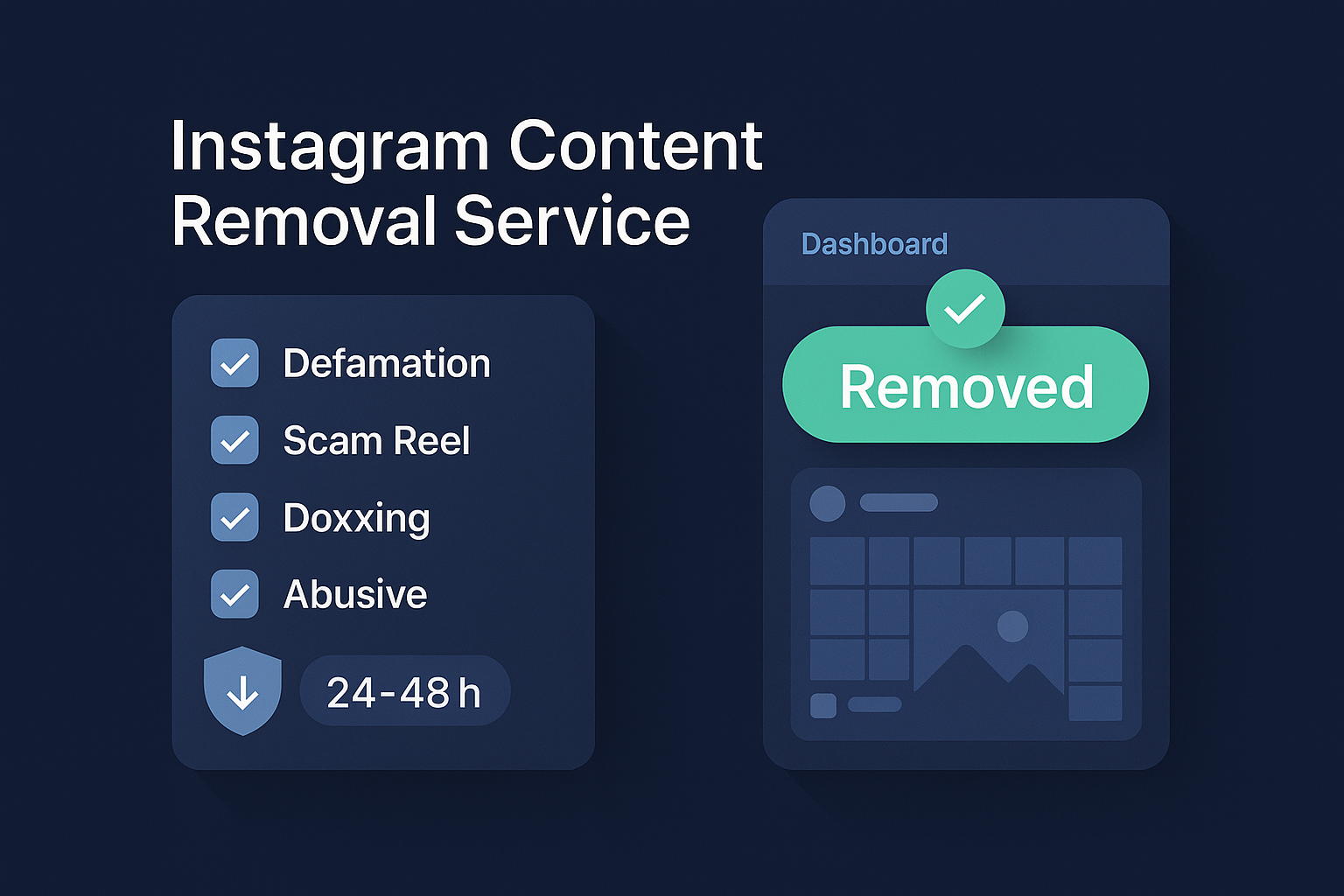
Most people search for one magic removal trick. There isn't one. What exists is four specific Instagram forms, each tied to a different kind of harm, and the whole result hinges on matching your situation to the correct one. Send a brand problem down the impersonation form and it stalls; send a stolen photo down a Community Guidelines report and it goes nowhere. This page walks the four routes, what each demands, and roughly how fast each moves.
Which official Instagram form matches your takedown?
Start by naming the harm, because the form follows it. A stolen photo or video you made is a copyright matter. Misuse of your registered brand name or logo is a trademark matter. A profile posing as you or your company is impersonation. A scam, harassment campaign, hate post or spam swarm goes through a Community Guidelines report. Picking the wrong category is the single most common reason a sound complaint gets left alone, so the table below pairs each harm with its form and the proof that form expects before a reviewer will act.
| The harm | Use this form | Who may file | Core proof needed |
|---|---|---|---|
| Your photo, video or design reposted | Copyright (DMCA) report | Rights holder or authorised agent | Proof you created the work |
| Your brand name, logo or mark misused | Trademark report | Trademark owner or agent | Registration details |
| An account posing as you or your brand | Impersonation report | The person impersonated | Government-issued ID |
| Scam, harassment, hate, spam | Community Guidelines report | Anyone | Screenshots of the breach |
One detail trips people up: a photo someone else took of you is usually a privacy or Community Guidelines question, not copyright, which is a line we untangle in getting a profile or post removed.
How do you report an account impersonating you on Instagram?
Report an impersonation account through Instagram's impersonation form, which only the impersonated person or a parent or authorised representative may file — and which asks for a government-issued ID. There are two paths to the same place:
- In the app. Open the fake profile, tap the ⋯ menu, choose Report → It's pretending to be someone else → Me (or the person or business it impersonates).
- Logged out, from a browser. Use Instagram's impersonation report form (help.instagram.com/contact/636276399721841) — this is the route if you do not have an account. It collects your name, email and a photo of your ID, which Instagram says it deletes within 30 days, then follows up by email.
Unlike a Community Guidelines report, an impersonation claim is not anonymous in the sense that you must identify yourself to Instagram. A fan or commentary account that is clearly labelled as a parody is not impersonation, so the ID step matters: it confirms the real you is the one filing.
How do you file an instagram dmca copyright takedown, step by step?
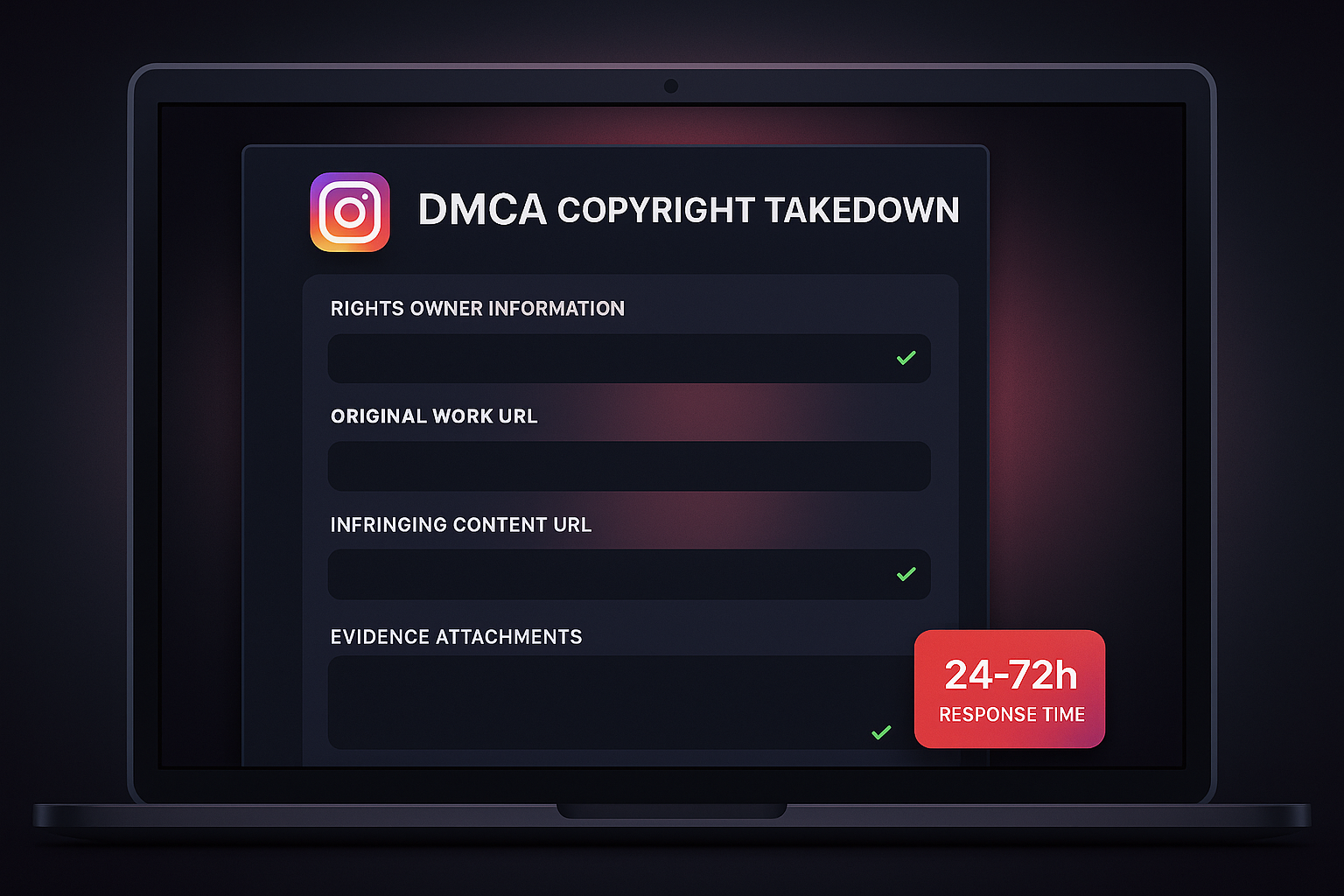
An instagram dmca copyright takedown is filed through Instagram's copyright report form by the person who owns the work, and U.S. law lists exactly what a valid notice carries (17 U.S.C. §512(c)(3)). No lawyer is required, but accuracy is, because a notice is a sworn legal statement. Here is the order it runs in:
- Confirm you own it. The work has to be yours to file — your photo, video, graphic or writing, not just one you reposted first.
- Gather ownership proof. The original file with its metadata, a first-publish date, or a higher-resolution copy than the infringing post carries.
- Open the copyright form. Use Instagram's dedicated copyright report form (help.instagram.com/contact/552695131608132), not the in-app three-dot Report, which does not route to the copyright team.
- Add the §512 elements. Identify your work, link the infringing post, give your contact details, a good-faith statement, and the declaration under penalty of perjury.
- Submit and log it. Save your reference and watch for a counter-notice, since the other side can dispute it.
The U.S. Copyright Office publishes the framework and a sample notice if you prefer to draft solo (copyright.gov). Rights holders who police infringement at scale can also apply for Meta Rights Manager, Meta's tool for matching and managing copyrighted media across Instagram and Facebook, rather than filing each notice by hand.
How do you report trademark abuse on instagram?
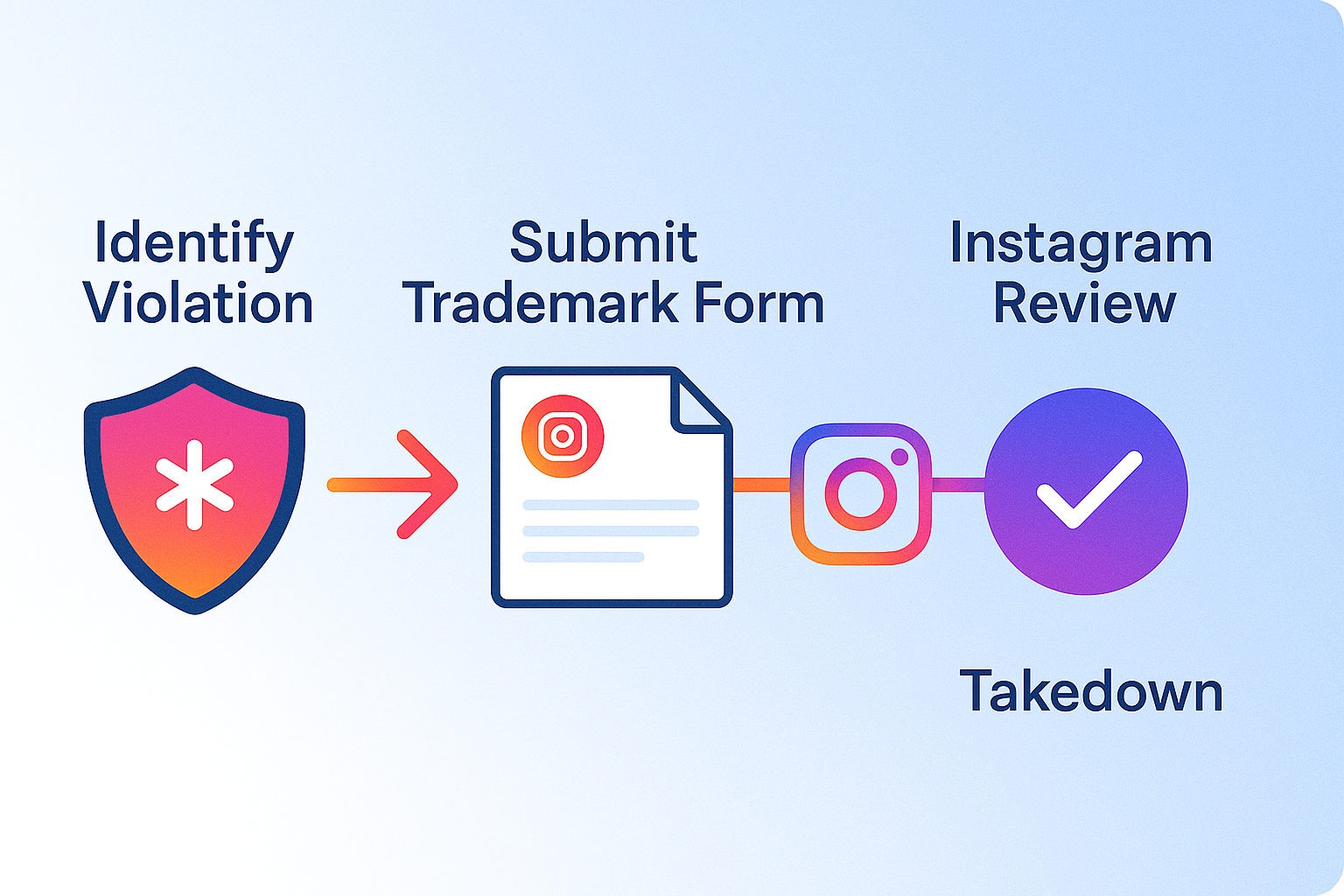
To report trademark abuse on instagram, use the dedicated trademark form, which sits apart from copyright and from impersonation (help.instagram.com/contact/230197320740525). It covers a counterfeit seller, a bogus "official" store, or an account squatting on your registered name or logo. Only the trademark owner or an authorised representative may file, and Instagram suggests trying to resolve it directly with the account first where that is realistic. Have your registration number ready and point to the exact post or bio element that misuses the mark. The classic mistake is filing brand misuse as "impersonation" — they are different problems with different evidence, and the mismatch is why an otherwise solid claim sits in limbo. If the goal is reclaiming a brand handle a violator parked on, that follows the evidence trail in reclaiming a taken username.
What gets a rule-breaking account taken down — and what doesn't?
Match the report to the rule and document it tightly; that is what moves a Community Guidelines case. Scams, harassment, hate and spam go through the in-app report or the Community Guidelines flow, with screenshots that show the username, the dates and the rule being broken. What does not work is volume. Instagram states plainly that the number of times something is reported does not decide whether it comes down, only whether it genuinely breaks a rule (Instagram Help Center). That single fact sinks two popular myths at once: mass-reporting a profile and the automated report bots sold on Telegram, which mostly steal logins and can flag the reporter as the abuser. The platform's own systems, not report volume, do the heavy lifting: Meta says it removed more than 159 million scam ads in 2025 and caught 92% of them before anyone reported them, and disabled roughly 10.9 million accounts tied to scam centres in the same year (Meta Integrity Reports, H1 2026). For anything touching child safety or a non-consensual intimate image, skip the routine form and go to the police, to StopNCII.org, and to the NCMEC CyberTipline (report.cybertip.org).
How long to get an instagram account taken down?
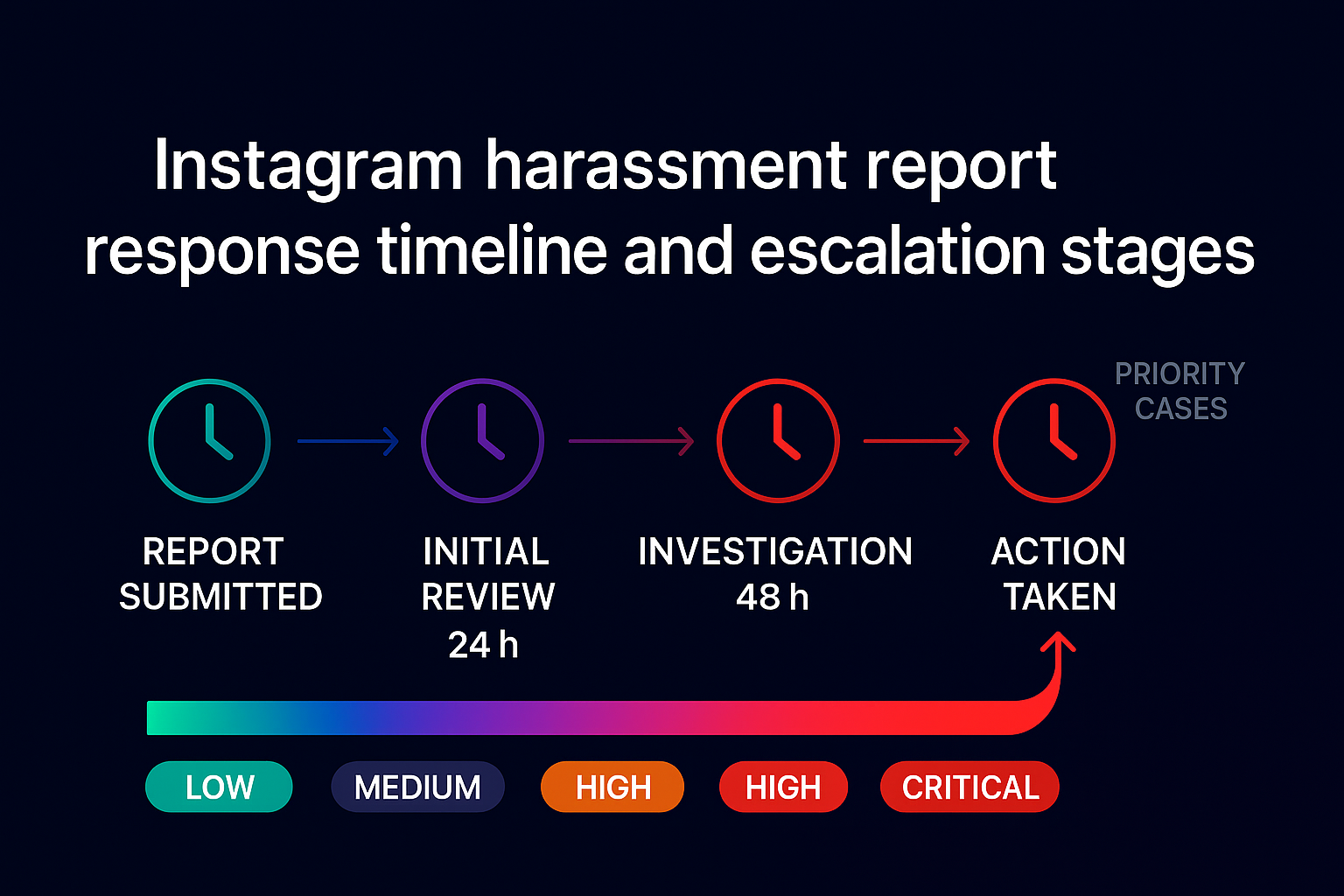
There is no fixed answer to how long to get an instagram account taken down, and any service quoting a guaranteed deadline is selling certainty it cannot deliver. As a working range, a clear-cut impersonation or Community Guidelines case with solid proof is often actioned within roughly 24 to 72 hours, and a copyright removal often lands within a few business days; a contested or multi-account case can drag on for weeks, and a handful never resolve. The one hard number comes from law, not Instagram: after a valid counter-notice, content stays down for 10 to 14 business days before it may be restored (17 U.S.C. §512(g)). Speed tracks evidence quality and how cleanly the case maps to a form, not how forcefully you complain. A single sworn copyright notice tends to outrun a week of duplicate Community Guidelines reports. If raw timing is your priority, how fast a violator actually comes down breaks the clock apart in more detail.
What happens after you file, and can the account return?
Filing is rarely the last step. A copyright takedown can be answered with a DMCA counter-notification from the person whose post you reported, and the platform must then restore the content within 10 to 14 business days unless you have gone to court (U.S. Copyright Office). So a removal holds only while the claim holds. If your own content was removed in error and you want to file a counter-notice, the §512(g) notice must carry four things:
- Your identity and contact details — legal name, address, phone and email.
- The removed content, identified — a description and the URL or location where it appeared before takedown.
- A good-faith statement, under penalty of perjury, that the material was removed by mistake or misidentification, plus consent to the jurisdiction of a U.S. federal court.
- Your physical or electronic signature.
There is a privacy cost worth treating as a numbered consequence of filing: a Community Guidelines report stays confidential, but a copyright or trademark notice hands your name and email to the person you reported, who is entitled to see who complained and to respond (Instagram confirms IP reporting is not anonymous). Removed accounts often pop back under a fresh handle, which makes watching for the re-up and refiling part of real takedown work. None of this rewards a false claim. The statute is blunt about it — anyone who "knowingly materially misrepresents" that material is infringing "shall be liable for any damages" (17 U.S.C. §512(f)) — and Instagram warns that fraudulent IP reports can get your own account terminated.
How many strikes does it take to get an Instagram account removed?
Instagram does not publish a fixed number. Removal runs on Meta's strike system, where each confirmed violation adds a strike, strikes carry escalating restrictions, and — this is the key fact — every strike on Facebook and Instagram expires one year after it is applied (Meta Transparency Center, Counting strikes). What disables an account is severity and repetition, not a tally of reports: a single severe violation, such as child sexual exploitation, can take a profile down on its first occurrence, while milder breaches accumulate before a permanent disable. So "how many strikes before deletion" has no public threshold by design — Meta decides case by case on what the content is and how often it recurs. That is also why piling on reports does nothing for you: it is the platform's own confirmed strikes, weighted by severity, that move an account toward removal.
Is an instagram takedown service worth it, or can you do it alone?
You can run every route here yourself for free, so an honest instagram takedown service buys you time and fewer filing errors, not secret access. A legitimate one reads the case, picks the right form, builds the proof, files officially and tracks the outcome — genuinely useful when you face several clones, a contested claim, or a report Instagram already shrugged off. What no real service does is guarantee removal, ask for your password, or claim an inside line to Meta; those are the tells of the "ban anyone" scams, and what a real arrangement actually costs and can't promise is worth reading before you pay anyone. We also handle the narrower jobs, like reporting spam and bot accounts the proper way. Tell us about the profile or post and we will say plainly whether it is a real violation, a free fix you can do yourself, or a case our solutions team can carry through official channels.
What if the report is rejected or nothing happens?
Silence or a rejection usually means a fixable gap, not a dead end. The most common reason a takedown is refused is thin proof of ownership, so before you refile, recheck three things: that you used the correct form for the harm, that your evidence names exact URLs and shows the rule being broken with dates and usernames visible, and that a copyright claim attaches genuine proof you created the work. Tighten the weakest link and submit again through the same official form. What does not help is firing off duplicate reports or piling on extra accounts — that adds noise, not weight, and can flag you. One note on safety: a real Instagram copyright or impersonation outcome arrives inside Instagram or by Meta email tied to the form you filed. An unsolicited "copyright infringement notice — your account will be deleted" email carrying a login link is phishing; treat it as a scam, never enter your password, and report it.
Sources & official references
Every claim above traces to a primary source. The reporting routes come from Instagram's own Help Center; the copyright mechanics from U.S. law and the Copyright Office:
- Instagram Help Center — the official forms: copyright report, trademark report and impersonation report.
- Instagram Help Center — why report volume does not drive removals and why IP reporting is not anonymous.
- Meta Transparency Center — Counting strikes and the Integrity Reports, H1 2026 (current enforcement scale).
- Legal Information Institute, Cornell Law School — 17 U.S.C. §512 (notice, counter-notice and §512(f) liability).
- U.S. Copyright Office — the Section 512 notice-and-takedown framework and sample forms.
FAQ
What is an Instagram account takedown?
It is the formal removal of a profile, post or photo through one of Instagram's own forms: the copyright report, the trademark report, the impersonation report, or a Community Guidelines report. The form you choose follows the harm. It is a policy or legal process, not a button a bot can press for you.
Is an Instagram takedown service worth paying for?
Sometimes. An honest Instagram takedown service maps your case to the correct form, assembles proof and files through official channels, which saves time on tangled cases like multiple clones. It cannot reach anything you could not file yourself for free, and any service that guarantees removal, wants your password or claims a Meta contact is a scam.
What proof do I need before filing a takedown?
It depends on the route. A copyright claim needs proof you created the work — the original file, a first-publish date or a higher-resolution copy. A trademark claim needs your registration number. Impersonation needs a government-issued ID. A Community Guidelines report needs screenshots of the rule being broken, with usernames and dates visible.
Can a takedown be reversed after the account comes down?
Yes. A copyright removal can be undone by a counter-notice, and the law then requires the content back within 10 to 14 business days unless you sue. Community Guidelines removals can be appealed by the account owner. That is why monitoring for a refiled handle is part of the job, not a one-and-done filing.
Does reporting an account more times speed up the takedown?
No. Instagram says the number of reports does not decide whether content is removed, only whether it genuinely breaks a rule. A coordinated pile-on adds nothing and can flag you as the abuser. One specific, well-evidenced report beats a hundred duplicates, and a valid IP notice outperforms any volume of reports.
Can I take down an account that just criticises me?
No. A negative review, an unflattering opinion, a parody or ordinary commentary is not a policy breach, and filing against it wastes the reviewer's time and can backfire. A takedown needs a real basis: a scam, harassment, impersonation, a copyright or trademark claim, or another genuine legal ground.
How do I report a fake account impersonating me?
Open the fake profile, tap the three-dot menu and choose Report, then "It's pretending to be someone else" and "Me". If you have no account, use Instagram's logged-out impersonation form at help.instagram.com/contact/636276399721841. Both require a government-issued ID, and only the impersonated person or an authorised representative may file.
How do I file a counter-notification to restore content Instagram removed?
If your post was taken down by a copyright claim you believe is wrong, send a §512(g) counter-notice with your legal name and contact details, a description and URL of the removed content, a good-faith statement under penalty of perjury that it was a mistake, consent to U.S. federal jurisdiction, and your signature. The content must then return within 10 to 14 business days unless the claimant sues.